
Fuselings
After Tanks! I wanted to see how the same stack holds up in a game where every tile matters, so I built Fuselings: a bomb arena game with a 3D look that I can play alone against bots or online against other people. It isn’t public yet, but it’s far enough along that I want to show it.
The game
You know the rules: drop bombs, blow up crates, grab power-ups, be the last one standing. The classic set is there: extra bomb, flame up, full fire, speed, kick, remote detonator, pierce, jelly bombs that bounce off walls, and a throwing glove that stacks up to three times. Then there’s the skull with seven diseases, from reversed controls to not being able to place bombs at all.
I borrowed a few things from the games I grew up with. Dead players end up on the edge of the arena and can keep throwing bombs into the arena. Hit someone from there and you’re back in. When the clock runs out, sudden death kicks in and the board closes in a spiral. Besides crates and walls, maps have conveyor belts and warp tiles. Dying isn’t quick here: arms, legs and head fly off, or the character crumbles to ash or falls apart. Which death you get comes from the shared seed, so every player sees the same one. Some floors change how you play: ice you slide on, mud and water that slow you down, plus lava and pits.
Singleplayer
The campaign is a sequence of stages, each one a last-man-standing round against bots. You start against one opponent, from stage 5 on it’s three, and the bots get better as you go. Lose and you replay the same map, since every stage has a fixed seed. Progress is saved.
The bots have four personalities: one hunts, one mostly tries to survive, one farms crates and power-ups, and one bombs the tile you were about to escape to.
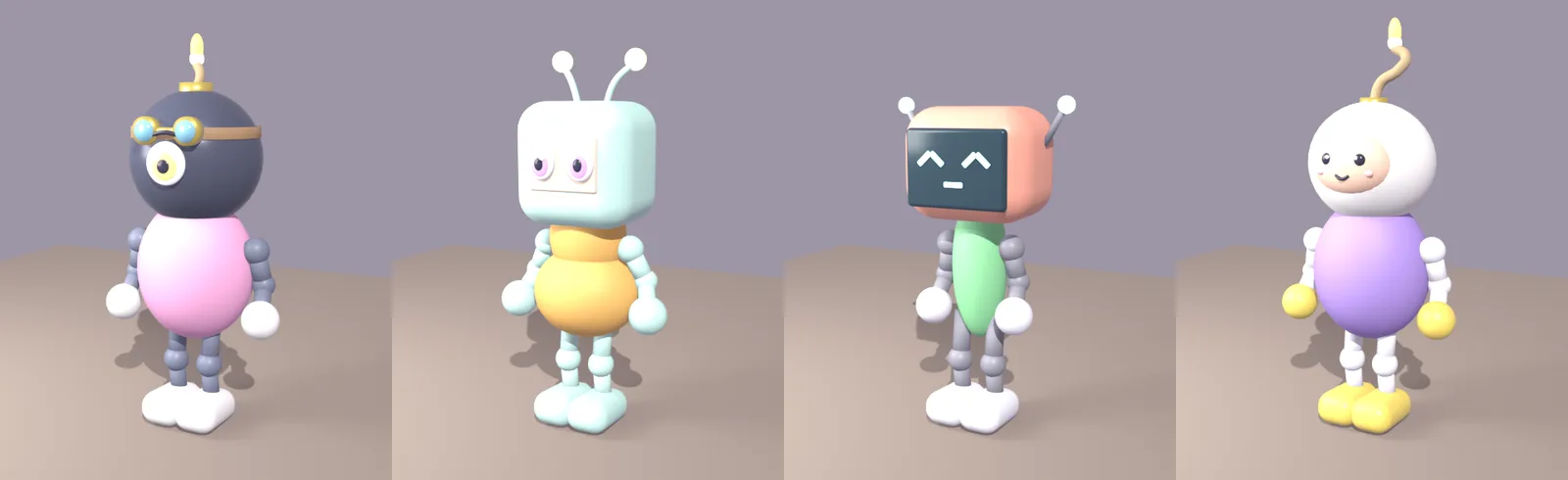
I’m rebuilding the characters right now. You’ll pick head, face and body separately in your profile, four of each, from a bomb head with goggles to a screen with antennae. Arms and legs get joints, and blinking, panic, cheering and anger show on the face. In multiplayer everyone sees your character, and the bots roll their own.
Multiplayer
The server is authoritative. Clients predict their own movement and get corrected when they drift. This runs on Lightyear, same as Tanks!. Lobbies can be filled up with bots. You find servers through LAN broadcast, direct connect, or a master server with a server list. A hub service spins up match servers on demand, which is what Quickplay and invite links use.
There are accounts with email verification or Google sign-in, an Elo rating and a leaderboard.
Since security is my field, the network side got more attention than a hobby game usually does:
- On servers registered with the master, each client gets its own signed ConnectToken instead of everyone sharing one key.
- Rate limits and sanity checks catch tampered input.
- Desync detection compares checksums and resyncs the map state when they don’t match.
Platforms
There are native builds for Linux and Windows, with signed releases and an auto-updater. In the browser it runs as WebAssembly, on WebGPU or WebGL2 depending on what the browser supports. Singleplayer there needs no server. Browser multiplayer goes over WebTransport through a proxy. That part is built but hasn’t been tested in real-world use yet. Touch devices get a virtual joystick.
Tech
- Engine: Bevy 0.20
- Networking: Lightyear 0.31 (UDP, WebTransport in the browser), fixed 60 Hz simulation
- Particles: bevy_hanabi on the GPU, with a mesh fallback for WebGL2 and weaker machines
- Music: generative, synthesized with fundsp and scheduled on a kira clock. There are no music files. Every map theme has its own style, from a shuffle on the meadow to an organ in the crypt.
- Backend: Axum for the master server and hub, Postgres for accounts and stats
Singleplayer and multiplayer share the same simulation. In singleplayer the client just drives the server code locally, which saved me a lot of duplicated logic.
Most of the visuals come from the map seed: five themes from grass to cave, procedural textures, time of day and weather (rain, storms, snow). Weather is purely cosmetic and never goes over the network, because every client derives it from the same seed.
What’s left is mostly polishing the game feel and a public test of browser multiplayer. There’s no release date yet.